


I’ve known Joolz online for years through New Zealand Mushroom Facebook groups, where our shared love of fungi, nature and creativity meant we were often crossing paths virtually and following each other’s work from afar.
This year, we finally got the chance to meet in person - and, naturally, that soon turned into some long fungi forays together. From Abel Tasman and Eves Valley to Pelorus Bridge, we’ve spent hours disappearing into the bush, searching the forest floor for unusual colours, shapes and species, comparing finds and coming home with plenty of photographs and fresh creative inspiration.
Julie “Joolz” Davies, who creates under the name Joolzart, has a wonderful way of translating those encounters into watercolour: scientifically recognisable fungi arranged in colourful, whimsical compositions that encourage people to look a little closer at what’s growing beneath their feet.
I wanted to find out more about where that fascination began, how a day in the bush becomes a finished artwork, and why fungi continue to provide such an endless source of inspiration.
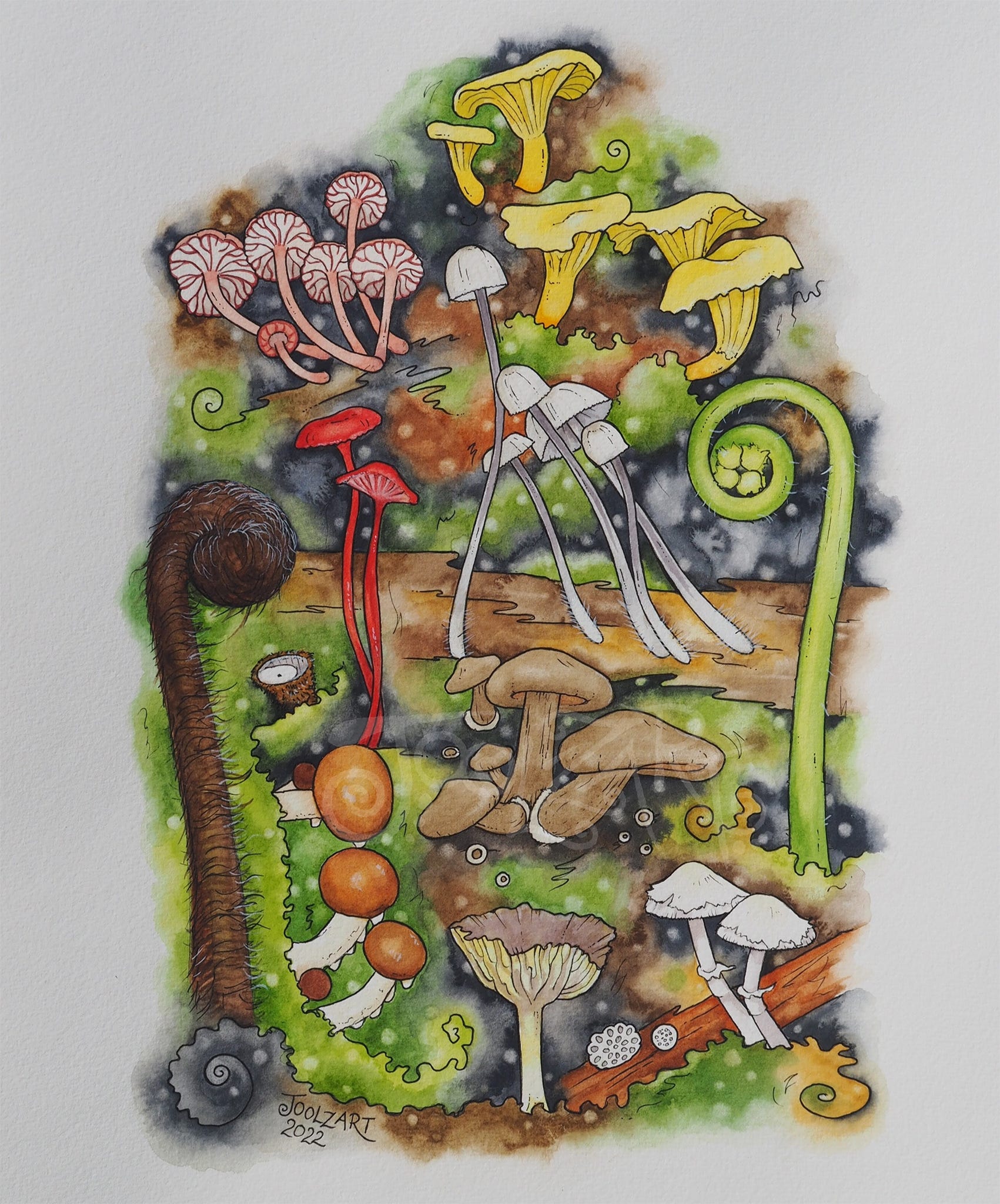
What first drew you to fungi as a subject? Was there a specific mushroom, forest walk, or moment that sparked it?
I was first drawn to fungi as a small child when my parents read me fairy stories from books with beautiful illustrations of Amanita muscaria in the scenes. I never did find any fairies from the books but did get to see these magical looking fungi on weekend nature walks in Delamere Forest, England.
They’ve featured in my artwork forever but came to be the main subject during the 2020 lockdowns when the 1000s of fungi I’d been photographing for many years became my main inspiration for what I painted.
How has the environment shaped what you create and how often you’re out foraging for inspiration?
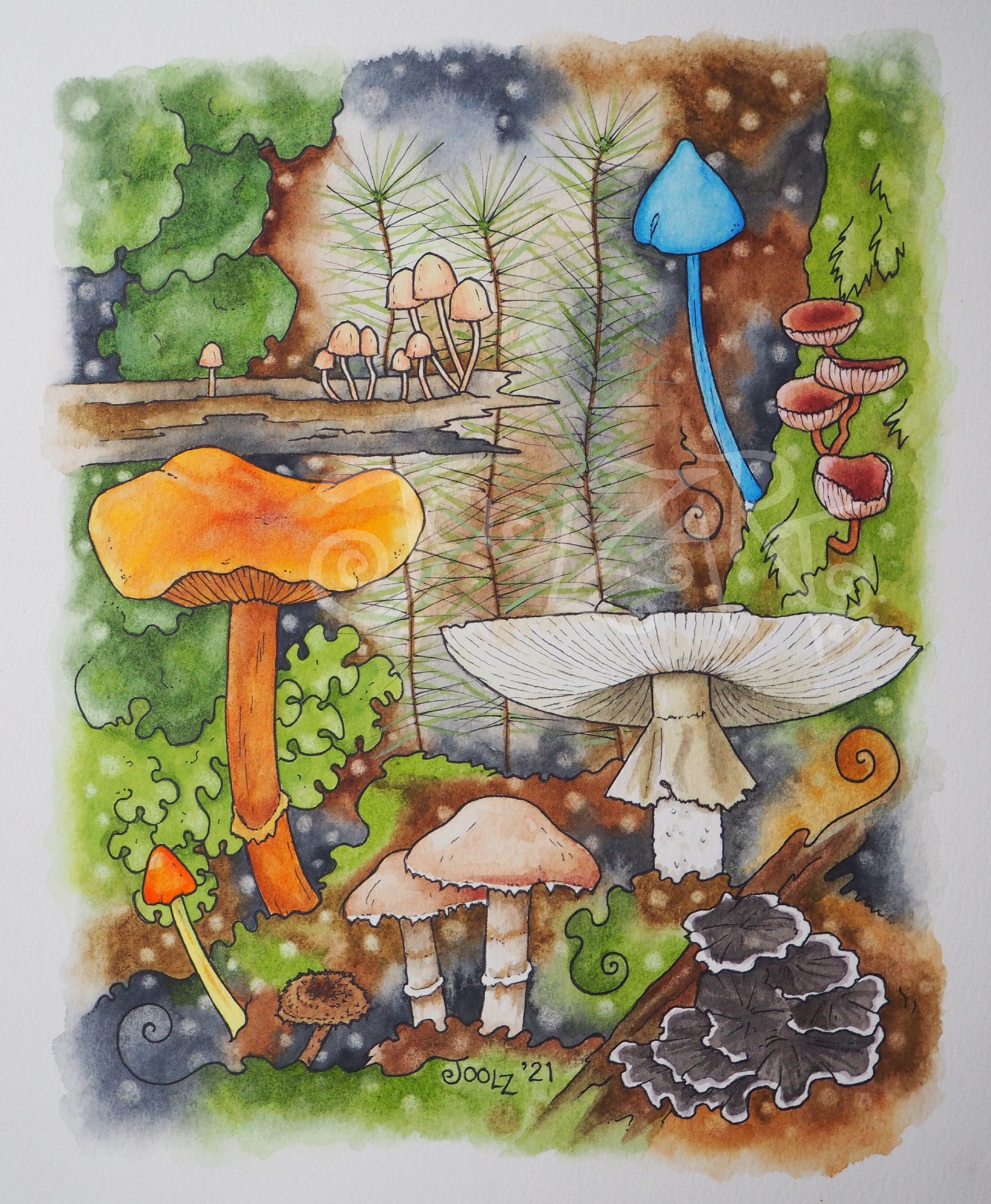
I’m always looking for fungi! I think most folk with an interest in mycology would say once you start to notice them you can’t unsee them.
You can always find at least a few species anytime of year but from mid April to late June I’m out bush looking for inspiration as often as possible.
May is officially ‘my month’, when I go off the radar to explore new patches of bush and, whenever possible, join the annual FUNNZ foray, organised by the Fungal Network of New Zealand, a non-profit mycological society that brings together amateur and professional fungi enthusiasts.
Walk us through your process from spotting something interesting in the field to the finished piece.
When I’m out looking for fungi it’s the colour and differences in texture that catch my eye. I love the range of colours to be found in Aotearoa NZ and on a fungi hunting mission I always do my best to find a rainbow of colours and a variety of different shapes.
Once I’ve found a pleasing subject I take several photos from different angles. I prefer not to use lighting as I want the fungi to look as it appears in the bush for accuracy of colour.
All the while I’m considering how they might fit into a design and what else I could find to compliment the subject.
I initially do pencil sketches of the individual fungi from my photography. I then work on a composition. It might be a creative scene from a particular area or something more abstract like my Koru/Spiral designs.
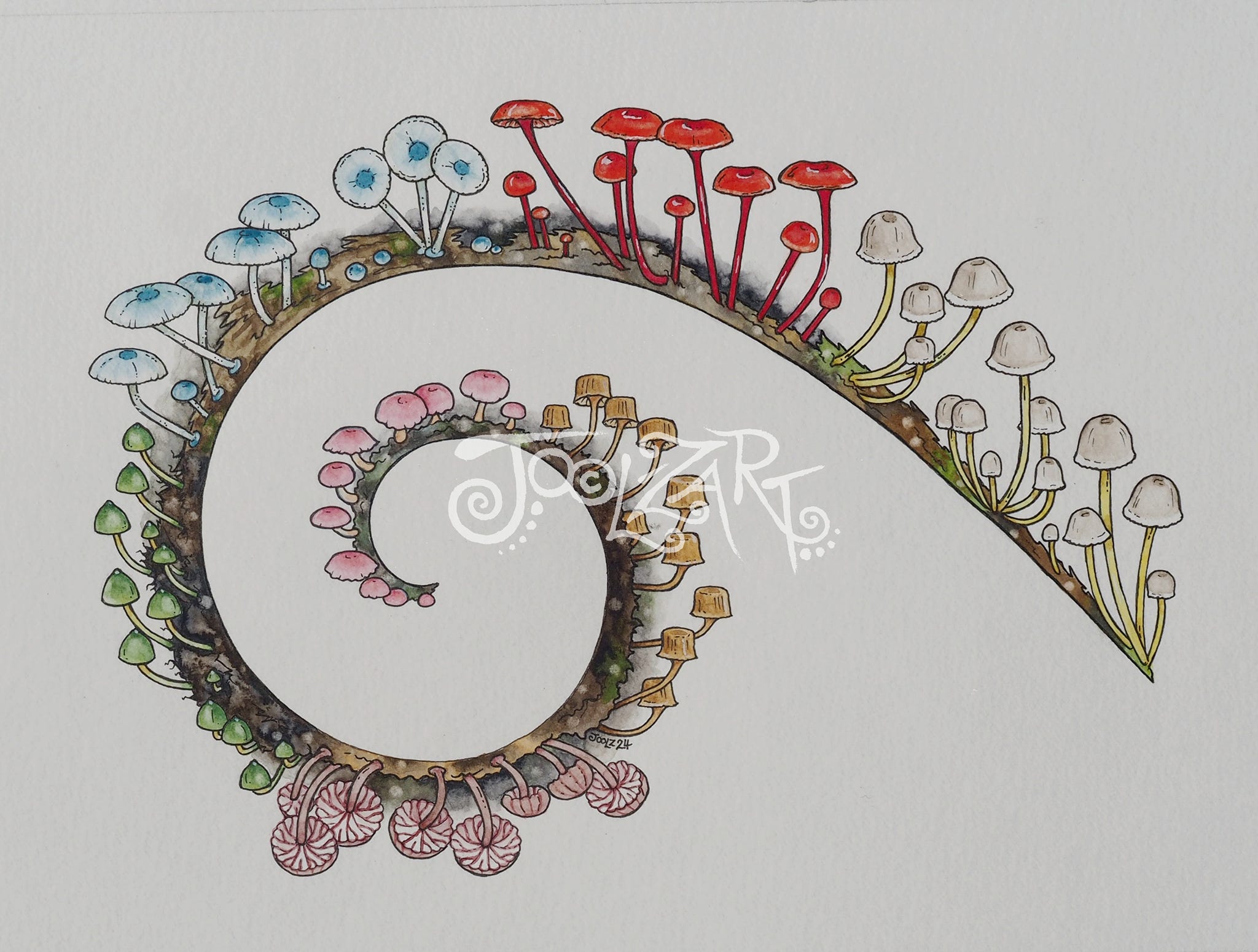
Once I’m happy with a pencil drawn layout, this is transferred onto watercolour paper. Next stage is inking outlines. Then the fun part, colour! I’ll add colour until I’m happy with the depth, lift some areas for highlights then finally go over ink lines for definition.
How do you balance scientific accuracy and artistic interpretation when photographing fungi?
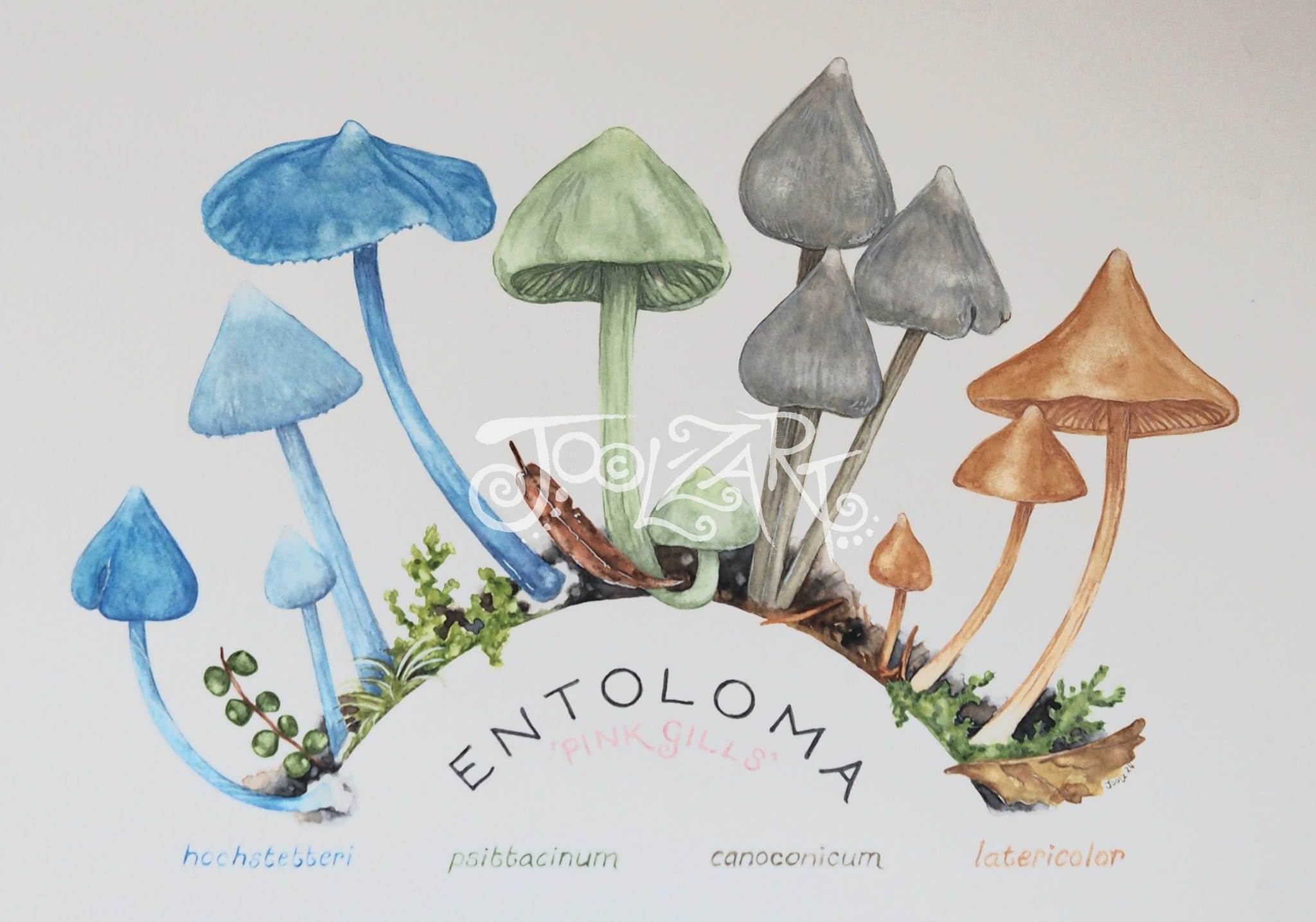
Having tried several mediums, watercolours are my absolute favourite for illustrating fungi.
I try to replicate the colours as I see them in nature and find the translucent quality of watercolours perfect for this. I can run several colours together to replicate the way cap colours transition naturally.
I can also add layer upon layer to create depth, and I often use white gouache, which is more opaque, for highlights on shinier fungi species.
I use fine-line pens to add a whimsical quality to my art. I don’t want my work to look like botanical illustration, but I do want it to be accurate, with enough detail that the species are immediately recognisable.
Is there a species that’s been especially difficult or rewarding to create, and what made it so?
Anything shiny is more difficult to recreate in watercolours due to the matt quality of the medium. I would say Gliophorus sp. are definitely the most challenging!
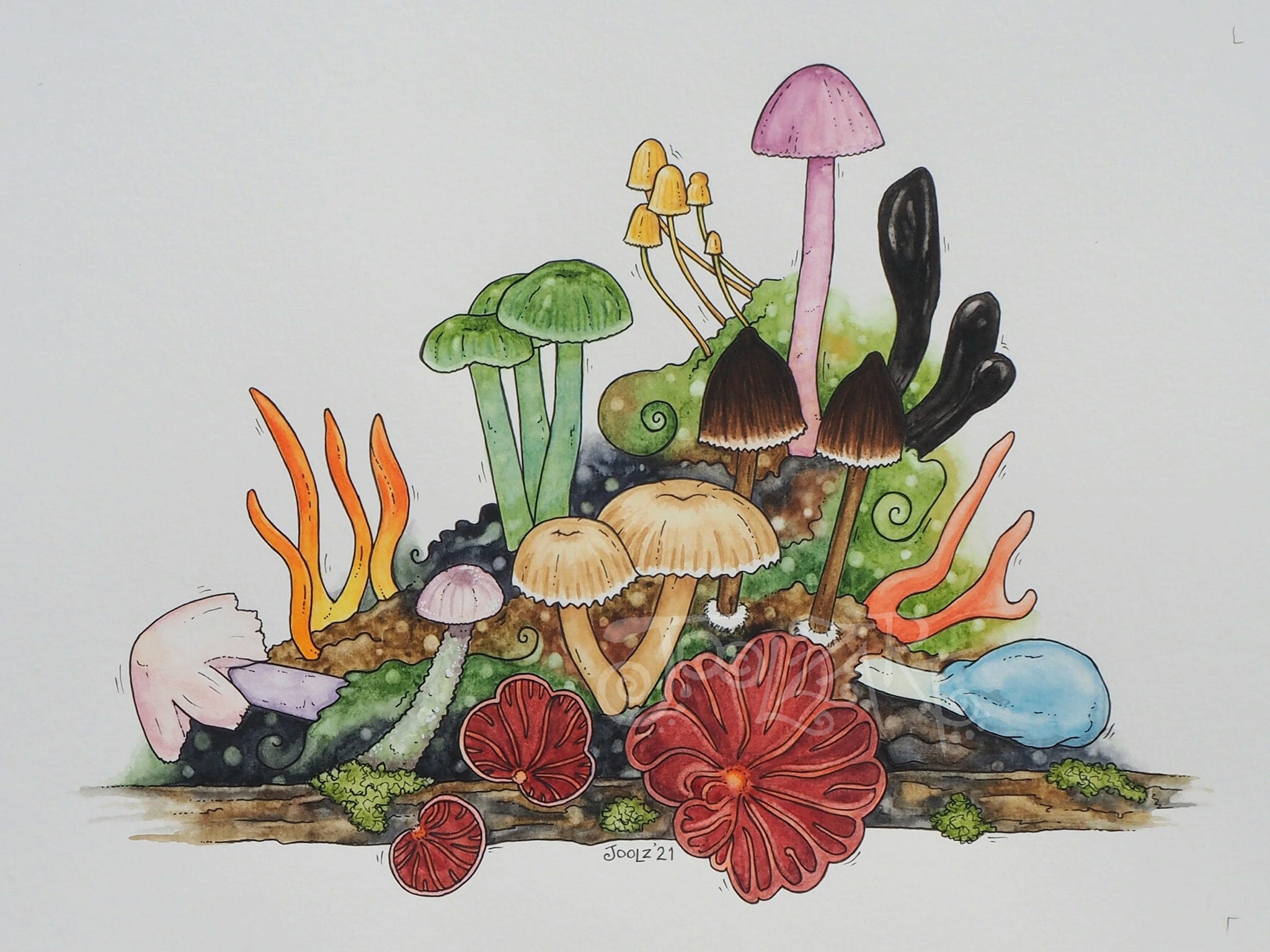
Your work goes out under the name Joolzart - what does that name mean to you, and how would you describe your style to someone who’s never seen it?
Joolzart encompasses all the art I create. Julie “Joolz” Davies was my nickname as a teenager and it just stuck, so it seemed like the obvious choice for the name! Although fungi are my absolute favourite thing to illustrate, I also paint birds, insects and other subjects.
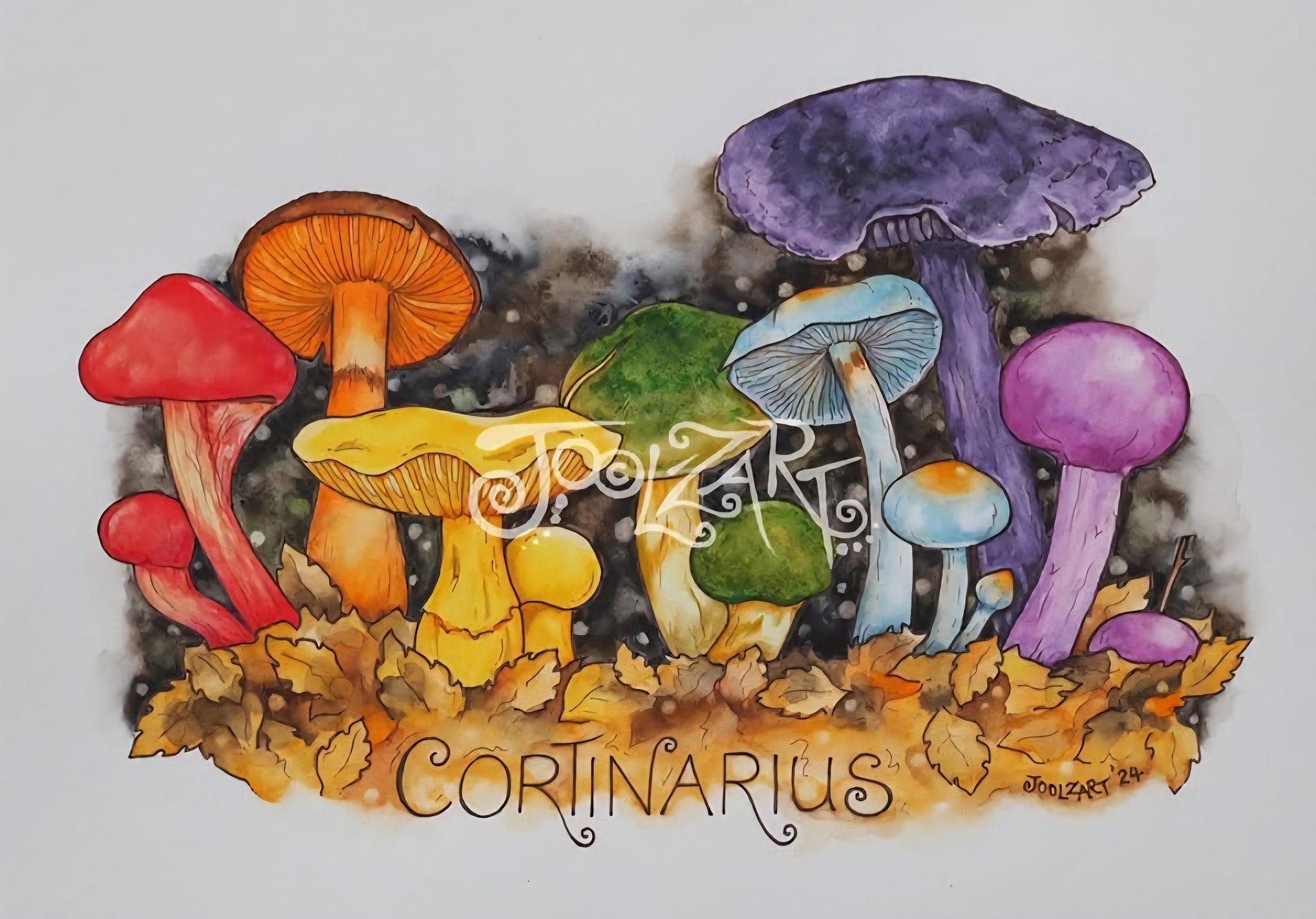
I would describe my work as creative and whimsical, while still being scientifically accurate.
Fungi have this reputation for being strange, hidden, even a little unsettling to some folk - how do you think illustration changes the way people feel about them?
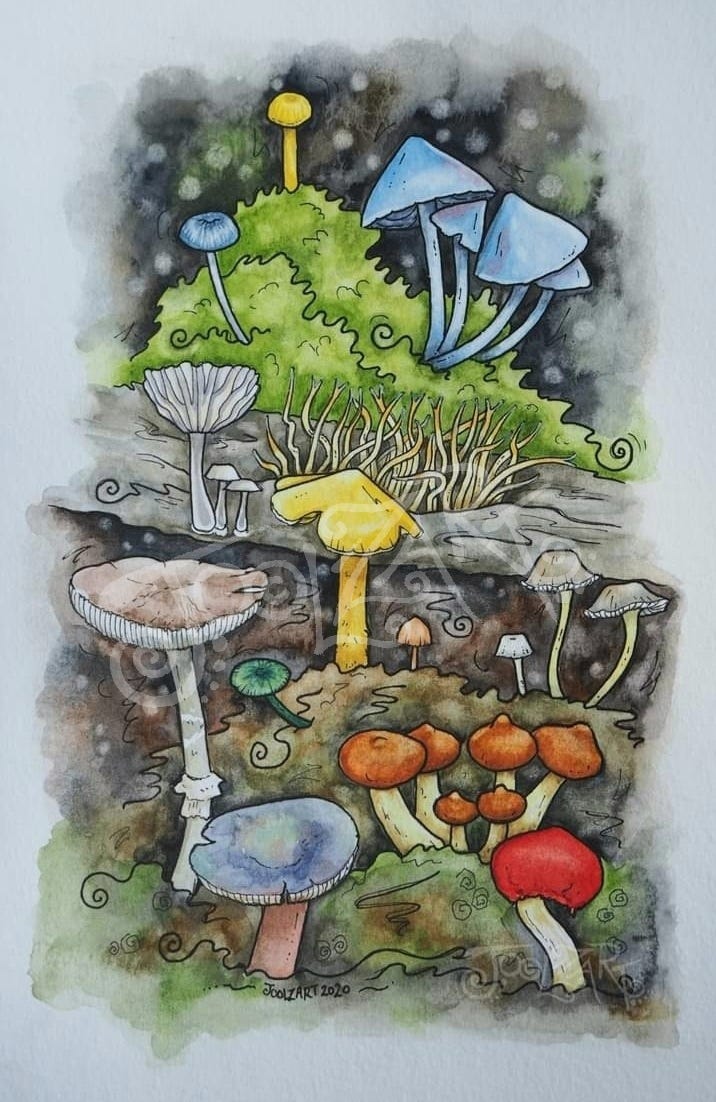
Most people wouldn’t think to get down on the ground and look underneath the cap to see the beautiful gill, teeth, or pore formations or to turn that log over to find the treasures beneath.
By creating illustrations I can show all of this and more in one scene. I hope that the colours and variety I illustrate inspire curiosity to look and learn more about fascinating fungi.
What role do you think artists play in getting people to care about fungi conservation and biodiversity, alongside scientists and photographers?
We are fungi ambassadors! The most common thing folk say to me when they see my art is, ‘I didn’t know there were so many colours and shapes out there!’ There’s rarely a research mission where someone doesn’t walk past and ask what I’m photographing. When they see what you’re looking at, you can almost hear the switch going on!
The majority of folk are aware of only a handful of species. By creating little scenes from one particular area, or bringing examples of a genus such as Mycena together in one design, I hope to show people the incredible diversity of species around them and spark an interest that wasn’t there before.
What’s next? Any series, exhibitions, or collaborations (fungi-related or otherwise) you’re excited about?
I’m really excited to be taking part in my first fungi art exhibition this November, alongside another artist who creates woodcut prints of fungi. It will be held at the Little Beehive Co-op on Hardy Street in Nelson, with dates and the exhibition title still to be confirmed.
I’m also working on a new way to offer my 12 fungi T-shirt designs. Rather than choosing from off-the-rack shirts, folk will be able to select the garment and customise the design they want.
After creating Fungi of Te Ika-a-Māui a few years ago, it’s now time to begin what will probably be the largest fungi piece I’ve ever created, titled Fungi of Te Waipounamu. It will be based on the fungi I found across the South Island this past season. It was a bumper year, so the piece will feature a huge variety of species and showcase the incredible range of colours, shapes and textures found in nature.
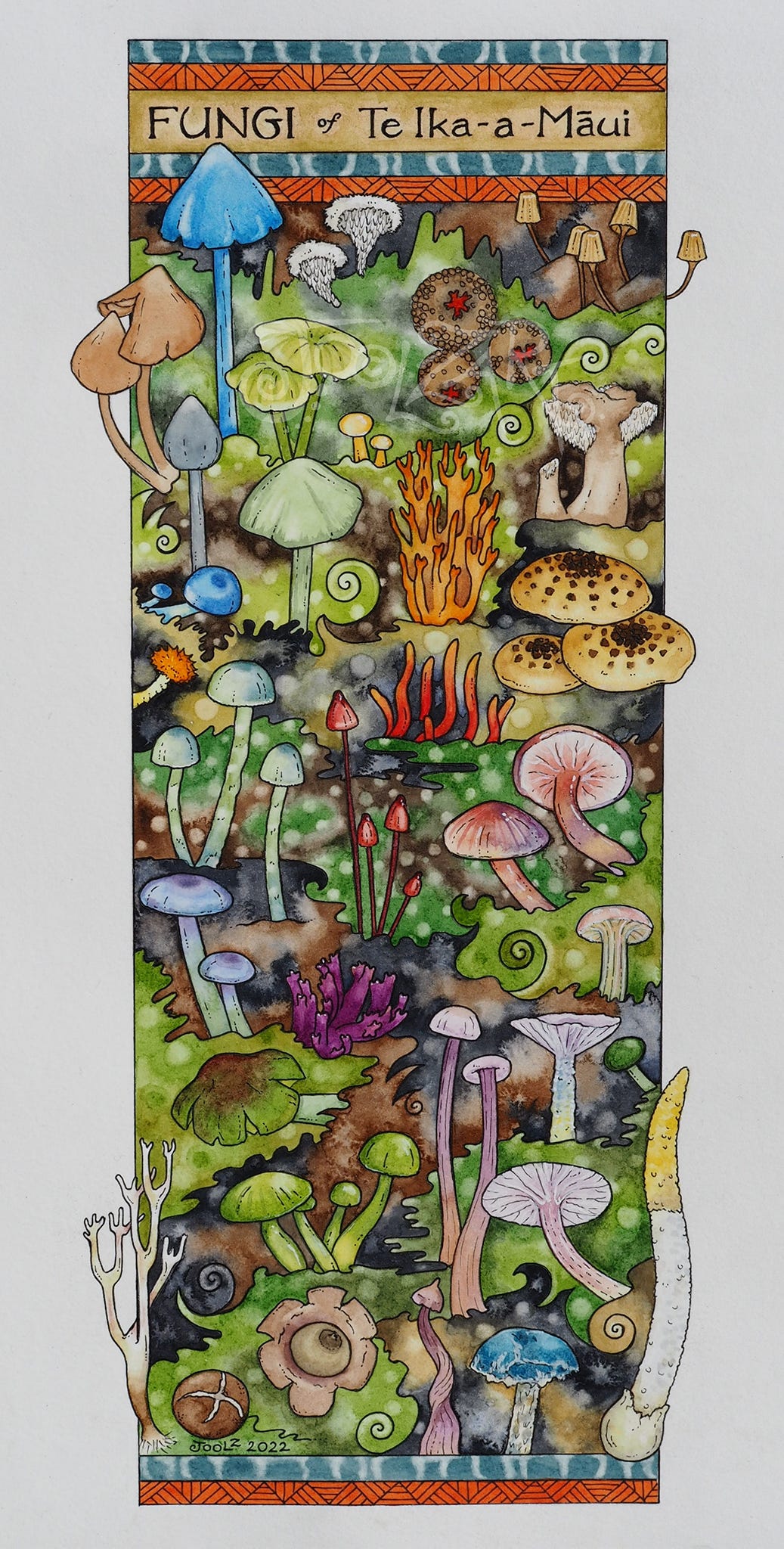
What comes through most strongly in Joolz’s work is her curiosity and ability to notice what others might overlook. After sharing a few forest adventures with her this season, it’s easy to see where that enthusiasm comes from. There’s always another species to find and another idea waiting to become a painting.
Follow Joolz on FB: @Joolzart68 or IG: @Joolzart_Aotearoa
Enquiries: joolzart68@gmail.com
Look, observe and witness magic 🙏
Could you please one day ask her if she has noticed any changes in the Fungi in the face of Global Warming..? Thanks..